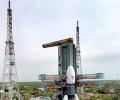
'In a part of the world where the government tells people what not to eat and what slogans to shout and not shout, it is beneficial to develop a mentality that is science minded and therefore open-minded.' 'That is possibly why the space programme has always had support from all sides of the political divide,' says Aakar Patel.

We sorted through countless photographs taken around the world to come up with the top photos of 2019. Together these images tell the story of the year -- capturing moments of hope and heartbreak, triumph and tragedy.

The Cuban government has announced nine days of mourning and has set Castro's funeral for December 4.

He was the army commander who planned Operation Bluestar. As army chief he planned Operation Brasstacks which rattled the Pakistan army. General K Sundarji was brilliant, ambitious and controversial, remembers Rahul Bedi.

Why did Kim Jong-un order his brother's murder?

The allocation in the defence budget is inadequate to meet India's long-term threats, especially from China and Pakistan, says Gurmeet Kanwal.
Seeking to boost the strategic ties, India and the US finalised the text of the Logistics Exchange Memorandum of Agreement.

How will the return of a majority government at the Centre, the new India-US friendship and the Mangalyaan triumph change India?

In the years to come, India's space assets will play a much bigger role if and when hostilities break out on our borders, says Pallava Bagla.

'Europe can be discussed on a golf course...' 'North Korea? What do I care what the man with the bad haircut does?'

Indian Navy Chief Admiral R K Dhowan enumerated a three-pronged strategy to counter the country's minified submarine fleet.

It is time to throw an outer ring around India's national security by proactively engaging in areas immediately outside our neighbourhood. Such a ring will not only insulate India from emerging threats, but also create new leverage in securing our own neighbourhood, says Nitin Pai.
If he doesn't, two things are guaranteed: Failure for him, and continued slide for his nation despite its talented people, strong nationalism, the gift of geography and a formidable army, points out Shekhar Gupta.

Irked by India's status as the world's biggest arms importer, Modi wants to build an advanced defence industry
'A conventional war is not in fashion today and not seen as being able to deliver the objective.' 'Perhaps surgical strikes that are deeper, this time not on Pakistan's terrorist facilities, but on Pakistan army facilities.' 'The nation has to be prepared for losses.' 'War is not something that can be pussyfooted around.' 'If we go for limited number of posts in Kashmir, these are very difficult posts to capture and very difficult operations.' 'Be prepared for 200 to 300 killed.'
'Where is the analysis that we need to spend at least Rs 4 trillion to keep India safe?'

'The domination of American foreign policy by the military poses some hidden dangers for us.' 'We must factor in that the Pakistani military and the US military have close ties going back three generations.' 'Pakistan will find sympathetic ears in the Pentagon against India as the bogey man.' 'This will be further milked to the maximum by raising the ante in Kashmir through its proxies,' warns Colonel Anil A Athale.
'As the tanks roll down Delhi's Rajpath and the C-17s fly overhead, there could be a lot brewing in Hyderabad House,' says Surya Gangadharan.

Narendra Modi's positive engagement with Barack Obama has well and truly washed away the doubts and slights of the past.

'This is the first time the US has formally recognised the threat India faces from terrorist organisations based in Pakistan.'

Boosting trade and simplifying visa regime, apart from security and defence cooperation, were among the key bilateral issues. The two leaders also discussed regional and international matters of mutual interest.

The plan hinged on two critical assumptions: India would not be able to replenish supplies quickly to launch a counter-attack. India could not respond in enough strength to dislodge the Pakistanis. Both assumptions would be proved wrong due to the ferocity of the Indian response, reveals former RAW officer Tilak Devasher in his new book, Pakistan At The Helm.
Every demand of the armed forces remains essentially anchored to 1964 and its fulfilment or otherwise largely a function of money availability

B S Prakash takes a tongue-in-cheek look at what India's neighbours think about the proposal of a SAARC satellite.

'If you take pride only in being a nation with nuclear weapons and a strong military, then you think very differently from those nations that take pride in having wonderful universities and academic institutions.'

The two countries also asked all nations to stop cross-border movement of terrorists and asserted that a decisive collective response from the international community without 'double standards and selectivity' was required to combat the threat of terrorism.

It would be foolish for Pakistan to assume that India would not act no matter what the provocation is, just because it is militarily more powerful than Myanmar and is armed with nuclear weapons, says Anand Kumar.
'If India employed a strategy of a 'thousand cuts', Pakistan will wither away.'

The conservative bureaucracy that influences the political masters is clearly not concerned with the vision documents prepared by defence chiefs to bring India's military into a state of preparedness, says Seema Mustafa

'It was almost as though there was widespread relief that the defence bureaucracy, and the minister, could find someone willing to shoulder the blame for everything that had gone wrong with the services under Antony's charge -- the poor preparedness of the forces, slow acquisitions caused by indecision, cancellation of contracts and whimsical blacklisting of defence contractors over the tiniest suspicion that they may have paid speed money or kickbacks.'

'If you destroy the assets in Pathankot, you degrade the combat potential of India; you degrade the war potential of India.'

The year 2014 is coming to an end. It was the year of conflict, the year of strife. Year 2014 will be remembered for several reasons -- the rise and threat of the Islamic State, the downing of two Malayasia Airlines aircraft and the sudden and effective way of using hastags on social media to generate a buzz about the event. After all, who can forget #theicebucket challenge and the phenomenon it grew into. Read on as we bring you an overview of international news and events of 2014.

'It is in the interest of both sides that the visit of the US President is seen as being successful. Both sides have invested considerable political capital in it. This rapid exchange of visits and the decisions taken have to be justified, beyond the symbolism, which is no doubt important in itself. This opportunity to impart a fresh momentum to ties should not be missed,' says former foreign secretary Kanwal Sibal.

Moving ahead with their new mantra -- Chalein Saath Saath: Forward Together We Go -- Prime Minister Narendra Modi and United States President Barack Obama on Tuesday vowed to deepen cooperation in every sector for the benefit of global stability and people's livelihoods over the next ten years.

The following is the full text of US President Donald Trump's first address to a joint session of the Congress on February 28, as prepared for delivery and released by the White House press office.
